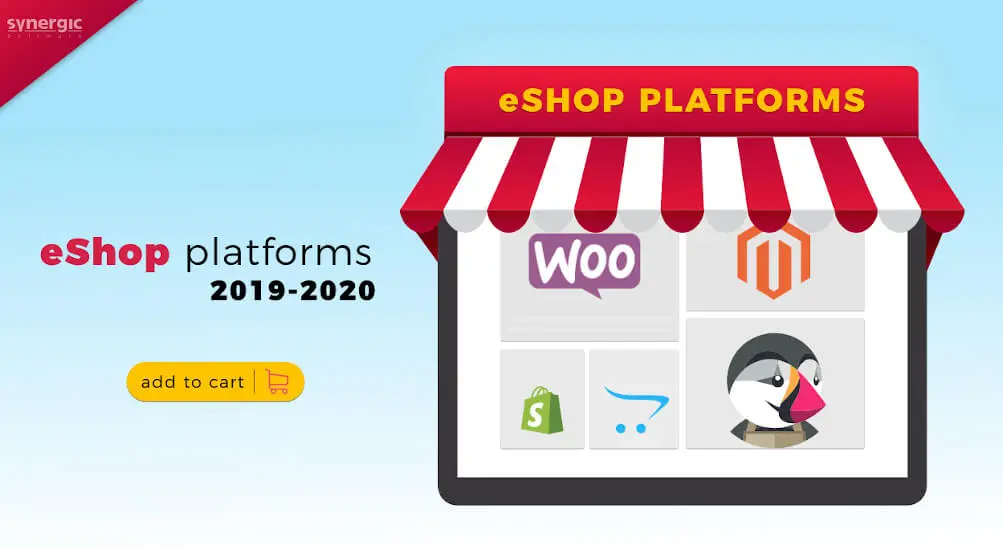
eShop Platforms 2020
Choosing the right platform for eShop development is a particularly important factor for your commercial success online.
As eCommerce continues to grow, smart decisions become increasingly important, while the consequences of poor choices become more significant. Your goals, available budget, products, and every other factor that shapes the creation of your eShop can only be fully utilized and maximize your chances of success if the technological environment supporting your new business activity is the right one.
Below, we briefly present the most popular eShop platforms for 2020, based on statistics from BuiltWith.com, so that you can gain an overall view of the latest technological trends in B2C eCommerce for small and medium-sized businesses.
TOP eSHOPS 2023
Discover the most popular eShop systems in 2023:
WooCommerce – Shopify – PrestaShop – OpenCart – Magento – Wix
WooCommerce (WordPress)
The well-known eCommerce plugin for WordPress already powers approximately four million active eShops, mainly small-sized online stores.
Its most important advantages compared with other platforms are its complete integration with WordPress and, consequently, the ability to use virtually any WordPress plugin. This gives users a wide variety of options and capabilities for creating a distinctive eShop.
Although WooCommerce is technically a plugin, it does not significantly lack features compared with other eCommerce software.
On the contrary, implementation costs are relatively low, while it offers considerable flexibility in terms of the sales process, allowing users to sell everything from physical products and downloads to subscriptions and even appointments.
Its main disadvantages are the relatively difficult implementation of multilingual functionality and a management environment that may not always feel fully cohesive.
PrestaShop
PrestaShop has been used since 2007 by more than 300,000 eShops belonging to small and medium-sized businesses in more than 195 countries.
With numerous built-in features and a highly user-friendly administration environment, it competes effectively with Magento in terms of functionality and Shopify in terms of usability.
One particularly useful and effective feature is its relatively easy and direct integration with leading online marketplaces such as Amazon, eBay, and Etsy.
PrestaShop combines advanced functionality with a very user-friendly dashboard, making it particularly suitable for users entering the world of eCommerce and eShops for the first time.
In addition, its use of the Symfony web framework makes PrestaShop a secure, reliable, and scalable platform for the development of specialized functionality.
Magento
Magento was created in 2008 and is widely used by large-scale eShops.
Its flexibility, combined with extensive customization and expansion capabilities, are some of the key advantages that make it one of the most powerful and reliable eCommerce software platforms.
In one of its earlier Magento 2 versions, two useful innovations were introduced: Hosted Fields and In-Context Checkout.
Hosted Fields facilitate the secure collection of sensitive customer information during payment, while In-Context Checkout reduces the need for users to repeatedly enter their PayPal account details for future purchases.
With strong functionality for managing multiple storefronts, easy implementation of multilingual content, support for different currencies and transactions, and advanced cross-selling and search features, Magento is a leading solution for large eShops.
OpenCart
OpenCart is a well-known and popular eCommerce platform in Greece, with hundreds of thousands of installations, primarily for small online stores.
It supports more than eighty core features and includes a relatively easy installation process.
It offers strong performance and usability, a broad range of extensions, fast loading times, and a management system capable of supporting multiple stores.
However, like WooCommerce, it often requires the installation of a large number of plugins in order to provide more complete functionality, while customization can be a relatively demanding process.
Shopify
Shopify is a completely different type of solution, as it is a service rather than an open-source platform like the systems mentioned above.
Nevertheless, it is used by a very large number of eShops worldwide.
As a hosted eCommerce solution, Shopify supports businesses of different sizes and provides owners with the tools required to develop their online sales activity through a wide range of eCommerce features.
It offers strong mobile usability and integrations with social media platforms, making social selling easier.
However, Shopify also has some important limitations.
It uses its own programming language, Liquid, rather than a more widespread language such as PHP, which can make customization more difficult for developers who are unfamiliar with it.
In addition, some advanced SEO functionality and extra features may require additional apps or costs, while transaction fees may apply depending on the selected plan and payment setup.
Flexibility, adaptability, performance, a large number of plugins, themes and templates, and above all continuous innovation and new ways of taking advantage of the global market are some of the main characteristics of the most popular eShop platforms.
If you are having difficulty choosing the right platform for your new eShop, you can find the most suitable solution here, based on your business plan.