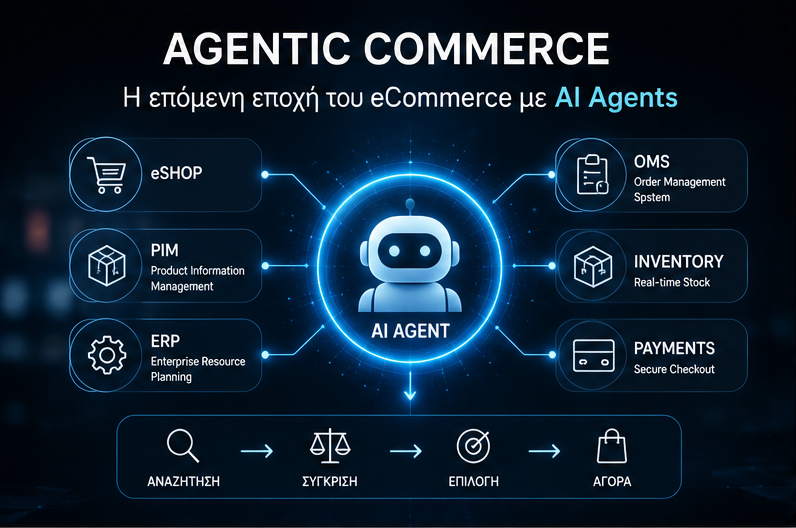
Agentic Commerce: How AI Agents Are Changing eCommerce and What eShops Need to Do Now
eCommerce is entering a new phase. For years, the typical online shopping journey was relatively predictable: consumers searched Google or visited an eShop, used filters, compared products, reviewed specifications and ratings, and eventually completed their purchase.
Artificial Intelligence is beginning to change that process.
Consumers can increasingly describe what they actually need using natural language: “I need a lightweight laptop for travelling, under €1,200, with excellent battery life,” or “Find me an ISOFIX child seat within this budget.”
Instead of manually completing dozens of searches and comparisons, an AI agent can take over a significant part of the process.
This is Agentic Commerce.
In 2026, this transition became significantly more visible. Google introduced the Universal Commerce Protocol (UCP), an open standard designed for agent-driven commerce, and has expanded capabilities allowing shopping agents to work with carts and access up-to-date product pricing and inventory. OpenAI has also developed richer shopping experiences in ChatGPT, while merchants can provide structured product feeds containing current price and availability information.
The implication is important: an eShop increasingly needs to be understood not only by humans and traditional search engines, but also by AI systems that discover, evaluate and compare products.
What Is Agentic Commerce?
Agentic Commerce is an emerging model of eCommerce in which Artificial Intelligence systems can act as digital shopping assistants on behalf of consumers.
Depending on the platform and available capabilities, an AI agent can:
understand a shopper's actual need,
discover relevant products,
compare specifications and options,
evaluate pricing and availability,
narrow down alternatives,
recommend the most appropriate product,
and, in certain commerce environments, participate in the purchasing process.
Shopify already describes agentic commerce as a model in which AI agents can research products, compare options and, in some cases, help complete purchases.
The key difference between an ordinary AI chatbot and an agent is action.
A chatbot can answer a question. An AI agent can interact with data, APIs and connected systems to perform steps toward completing a defined objective.
From “Search & Click” to “Ask & Buy”
Traditional eCommerce has largely been built around search.
Consumers enter keywords, open search results, visit several pages and compare alternatives until they find an appropriate product.
AI shopping gradually shifts this experience from search to conversation.
Consumers no longer need to know the exact product name or technical term they should search for. They can describe their problem, preferences and limitations.
For example:
“I need running shoes for everyday road running. I weigh 90 kg and want to spend less than €150.”
An AI system can translate this requirement into specific commercial attributes and identify products that better match the shopper's needs.
OpenAI has already introduced shopping research capabilities that allow users to describe what they need in natural language and receive researched and compared product options.
How Does an Agentic Commerce Journey Work?
A modern agentic shopping journey can include several stages.
The consumer starts by describing a need.
The AI agent interprets the shopper's intent and identifies the most important requirements.
It then searches available product catalogs and commerce environments.
Products may be compared according to price, specifications, stock, variants, shipping options, reviews and other available information.
The agent can then narrow the selection and explain the differences between the most relevant products.
Depending on the commerce platform and integrations available, the user can then be directed to the retailer's eShop or continue further through an agent-enabled checkout process.
This creates an entirely new customer touchpoint:
the AI interface.
Product Data Becomes Even More Important
High-quality product information has always been important in eCommerce.
In Agentic Commerce, it becomes critical.
An AI system should not simply know that a product is called:
“Running Shoe X200.”
It needs enough information to understand:
who the product is designed for, its specifications, available sizes and colors, current price, inventory status, brand, GTIN/EAN, category and the consumer needs it can address.
OpenAI supports structured product feeds containing up-to-date product price and availability information, while Shopify is similarly emphasizing structured and standardized product data for AI commerce channels.
This is where PIM — Product Information Management — systems become increasingly important.
A properly implemented PIM can become the centralized source for:
product titles, descriptions, specifications, categories, attributes, images, media, translations, SEO content and channel-specific product information.
Product data quality is therefore evolving from a catalog management issue into a factor affecting AI discoverability.
Real-Time Pricing and Inventory
An AI recommendation provides limited commercial value if the suggested product:
is no longer available,
has changed price,
is unavailable in the required size,
or cannot be delivered to the shopper's location.
Agentic Commerce therefore increases the importance of accurate, continuously updated commercial data.
Google has already expanded UCP so shopping agents can retrieve real-time product information including pricing and inventory.
This makes integrations across:
eShop → ERP → Warehouses → PIM → Marketplaces → AI Channels
increasingly important.
OMS: The Next Critical Component
Product Information Management answers the question:
What are we selling?
An Order Management System helps answer:
How will we fulfil the sale?
When a company receives orders from eShops, marketplaces, physical stores, social commerce and eventually AI-driven channels, centralized order management becomes essential.
An OMS can coordinate:
inventory,
warehouses,
physical stores,
couriers,
order routing,
fulfilment,
returns,
click & collect,
and customer order updates.
In the Agentic Commerce era, success will not depend only on whether an AI agent can find a product.
It will also depend on whether the business can efficiently fulfil the resulting order.
ERP, CRM and APIs
Agentic Commerce is not simply another plugin.
For a mature retail organization, it becomes part of a broader technology ecosystem.
The eShop may need to communicate with:
ERP,
CRM,
PIM,
OMS,
payment gateways,
courier systems,
marketplaces,
analytics,
loyalty platforms,
and other external services.
APIs provide the communication layer connecting these systems.
The more structured and interoperable a company's architecture is, the easier it becomes to integrate new commerce channels as they emerge.
SEO and AI Search
SEO is not disappearing.
But traditional search is no longer the only form of online product discovery.
A product can increasingly be discovered through:
Google Search,
Google Shopping,
a marketplace,
social media,
ChatGPT or another AI assistant,
an AI shopping environment,
or a recommendation engine.
This creates a new requirement: product information and business content need to be understandable not only by traditional search engines but increasingly by AI systems as well.
This makes the following even more important:
structured data,
complete product attributes,
high-quality descriptions,
valid product identifiers,
accurate product feeds,
current pricing,
inventory availability,
and consistency across every commerce channel.
Why Should Businesses Prepare Now?
Agentic Commerce is still relatively early, but the growth is already visible.
According to Shopify's Q1 2026 commerce data, AI-referred orders grew nearly 13 times year over year, while referral sessions from AI chatbots grew more than eight times.
Shopify has also developed Agentic Storefronts that can make eligible merchants' products discoverable through AI channels including ChatGPT, Microsoft Copilot and, for eligible stores, Google AI Mode and Gemini.
This does not mean traditional eShops are disappearing.
It indicates that a new commerce channel is emerging.
Businesses previously had to adapt to marketplaces, mobile commerce and social media. The next adaptation will increasingly involve AI-driven commerce.
What Should an eShop Do Today?
Preparing for Agentic Commerce should not begin with installing an “AI plugin.”
It should begin with the foundations.
Businesses should ensure they have:
A clean and structured product catalog.
Complete and accurate product attributes.
Consistent SKUs, EAN/GTIN identifiers and brand information.
Real-time or frequent inventory and price synchronization.
PIM for centralized product information when managing large catalogs.
OMS for managing orders across multiple sales channels.
Reliable ERP, CRM, courier and payment integrations.
Structured data and properly maintained product feeds.
An API-ready architecture.
Analytics capable of identifying traffic, leads and orders generated by AI and other commerce channels.
These capabilities are not useful only for Agentic Commerce.
They are the foundation of a properly organized modern eCommerce ecosystem.
The eShop of the Future Is More Than a Website
The eShop is evolving from a standalone website into a central commerce infrastructure.
The storefront seen by the customer is only one of the places where a transaction may originate.
The same product may simultaneously appear:
in the eShop,
on a marketplace,
in Google Shopping,
on social media,
inside a mobile application,
in a physical store,
and increasingly inside an AI conversation.
For this model to work correctly, every channel needs access to reliable and synchronized information.
This is why technologies such as PIM, OMS, ERP integrations, APIs and automation are becoming central components of next-generation eCommerce.
Conclusion
Agentic Commerce is more than another Artificial Intelligence buzzword.
It represents a potential new stage in the way consumers discover, evaluate and purchase products online.
The businesses best prepared for this change will not necessarily be those that install an AI tool first.
They will be the businesses with the right digital foundations:
high-quality product data,
centralized product management,
accurate inventory,
organized order management,
connected enterprise systems,
and an architecture capable of supporting new commerce channels.
eCommerce is becoming increasingly automated, interconnected and data-driven.
Agentic Commerce is one of the most important next steps in that evolution.